
When it comes to aesthetics vs functionality in web design, the real success lies in balance. A beautiful website may attract attention, but only a functional one keeps users engaged and drives conversions. Conversely, a purely functional site without visual appeal risks losing trust and interest. The best websites combine stunning visuals with seamless usability, ensuring they delight visitors while helping them achieve their goals effortlessly.
Why Aesthetics vs Functionality in Web Design Matters
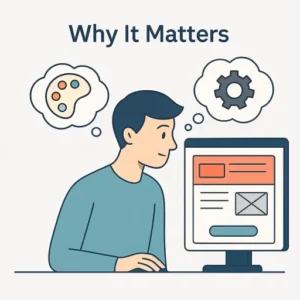
First Impressions Shape Trust
Studies show users form opinions about a website in just 0.05 seconds. An outdated or unattractive design creates instant mistrust. Aesthetics matter because they communicate professionalism and brand value at first glance.
Functionality Drives Conversions
While aesthetics pull users in, functionality ensures they can navigate, act, and convert. If visitors can’t find what they need quickly or face broken buttons, they’ll abandon the site.
SEO and Core Web Vitals
Google ranks sites partly based on Core Web Vitals, which measure speed, responsiveness, and stability. This means poor functionality hurts both user experience and search visibility.
Key Principles for Balancing Aesthetics and Functionality in Web Design
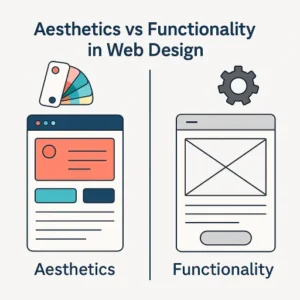
1. Start with User Experience (UX)
Every design choice should be rooted in user needs.
E-commerce: fast product filters, one-click checkout.
Service websites: prominent CTAs like Book a Call or Get a Quote.
Case in Point: Airbnb’s site is visually clean but prioritizes its core functionality — search. This aligns design with purpose.
Read more at Nielsen Norman Group, pioneers in UX research.
2. Clean, Purpose-Driven Design
Use white space to make content digestible.
Apply consistent typography for hierarchy.
Leverage color psychology (blue = trust, red = urgency).
Ask yourself: Does this design element support user goals? If not, remove it.
3. Speed Is the Invisible Design Layer
A visually rich design that loads slowly frustrates users.
Compress images (WebP format recommended).
Enable caching & CDNs.
Avoid unnecessary animations.
Amazon found every 100ms of delay cost 1% in sales. That’s how performance affects revenue.
Check Core Web Vitals for guidance.
4. Mobile-First Responsiveness
Over 60% of traffic comes from mobile (Statista). A functional design must adapt seamlessly:
Grid layouts for scaling
Touch-friendly navigation
Fast loading on smaller devices
Balancing aesthetics vs functionality in web design is especially critical on mobile, where screen space is limited.
5. Accessibility = True Usability
Accessibility is often sacrificed for aesthetics, but it’s part of functionality. Follow WCAG guidelines:
Add alt text for images
Ensure color contrast
Allow keyboard navigation
Accessible design isn’t just ethical — it broadens your audience and reduces legal risks.
6. Navigation and CTAs
Limit top-level menus to 5–7 items.
Use breadcrumbs for clarity.
Place CTAs prominently and ensure they’re action-oriented (e.g., “Start Free Trial”).
See HubSpot’s CTA examples for inspiration.
Real-World Examples of Aesthetics vs Functionality in Web Design
Apple: Clean design meets seamless product navigation.
Dropbox: Minimal aesthetics highlight powerful core functions (file sharing).
Netflix: A visual content grid paired with flawless streaming functionality.
Shopify: Stylish themes, but checkout flow is optimized for speed.
Mesh Maids (Service business): Clean booking form converts better than heavy visuals.
Common Mistakes to Avoid
Over-designing: Too many animations/fonts/colors create confusion.
Ignoring speed: Large videos and unoptimized images cripple performance.
Weak CTAs: Multiple conflicting CTAs dilute conversions.
Excluding accessibility: Fancy design but unusable for many.
Best Practices for Designers and Businesses
For Designers
Work with style guides.
Test prototypes with real users.
Prioritize mobile-first frameworks.
For Businesses
Avoid “pretty but pointless” redesigns.
Run A/B tests on layouts and CTAs.
Use heatmaps to refine usability.
Future of Aesthetics vs Functionality in Web Design
AI-Driven Personalization: Sites adapting visuals and features to user behavior.
Voice UX: Ensuring functionality works with voice search and assistants.
Minimalism with Micro-Interactions: Clean visuals enhanced by subtle, functional animations.
Sustainability in Design: Fast, lightweight sites consuming fewer resources.
FAQs
Q1. What does aesthetics vs functionality in web design mean?
It’s the balance between visual appeal (design) and usability (performance, navigation, and goals).
Q2. Which is more important: aesthetics or functionality?
Functionality ensures usability, but aesthetics builds trust. Both must work together.
Q3. How can I test if my site balances both?
Track bounce rates, conversion rates, and load times. Run usability testing.
Q4. Does this balance help SEO?
Yes. Google prioritizes sites that are visually engaging, mobile-friendly, and functional.
Q5. What future trends will impact this balance?
AI personalization, voice UX, and sustainable, lightweight designs.
Actionable Takeaways
Audit your site for both beauty and usability.
Aim for a 2-second load time.
Design mobile-first and accessible by default.
Add CTAs that guide user action clearly.
Continuously test, track, and improve.
Final Thoughts
The debate of aesthetics vs functionality in web design isn’t about choosing one — it’s about finding harmony. A visually attractive website draws users in, but functionality ensures they stay, engage, and convert. The winning formula for 2025 and beyond is clear: beauty attracts, functionality converts.